Project report
Here you get a little glimpse into the story of the DümmerGänse:
- The plan
- The start
- Incubation
- Hatching
- Among geese
- The first flight
- Weaning
- Farewell
- The (provisional ?) end
The plan
It all began with a dream: to live among geese once, like Konrad Lorenz, to be part of their community and to enjoy the trust of these social and intelligent animals.
From this grew the plan to raise a group of greylag geese by hand and then give them a life in freedom.
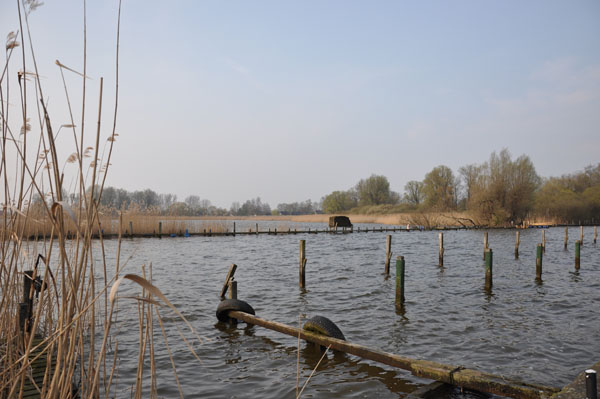
The Dümmer region with its nature reserves seemed the ideal place for it. For one thing, greylag geese live there all year round and regularly raise their young. For another, up to 30,000 white-fronted, bean and greylag geese spend the winter in the region every year. Ideal conditions, then, to make it easier for our charges to join wild geese.
The start
In autumn 2008 things get concrete: we “reserve” eggs from a farmer in the region who keeps greylag geese as ornamental birds. We also rent a little house near the shore of the lake for the spring and summer of 2009 and, as it turns out in the course of the project, for the autumn as well.
Incubation
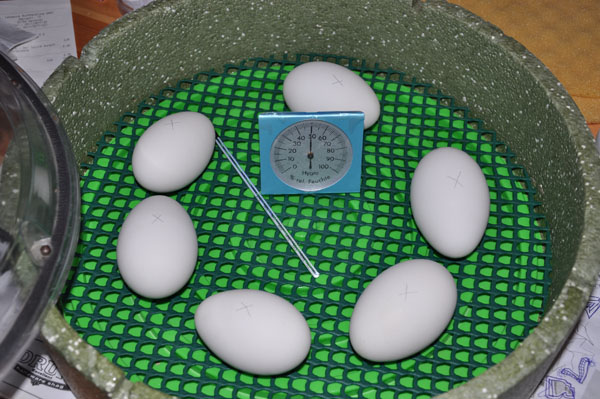
On 27 March 2009 the time has finally come: we put 6 greylag eggs into the incubator, and the long wait begins. The eggs are turned, moistened and aired regularly, just as a real mother goose would have done. This is extremely important, so that the little ones in the egg do not stick to the inside of the shell, dry out or get too little oxygen. What’s more, a real mother goose would constantly have been making sounds on her clutch, so that the little ones get to know their mother’s voice while still in the egg. As an alternative programme, we read aloud to our goose eggs every day from the adventures of little Nils Holgersson. And sure enough, two days before hatching, the eggs answer us with quiet peeping and visibly wobble as they do so.
Hatching
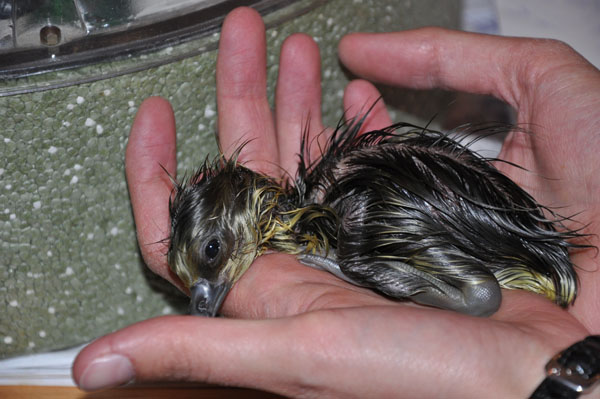
Exactly 28 days after incubation began, in the night of 23 to 24 April, the moment arrives: Leno, Fussel and Julchen fight their way through the hard eggshells. They cannot lift their heads yet, but they are already peeping and crowing for their parents. Excited and overjoyed, we welcome them and tuck them under our jumpers to keep them warm.
Among geese
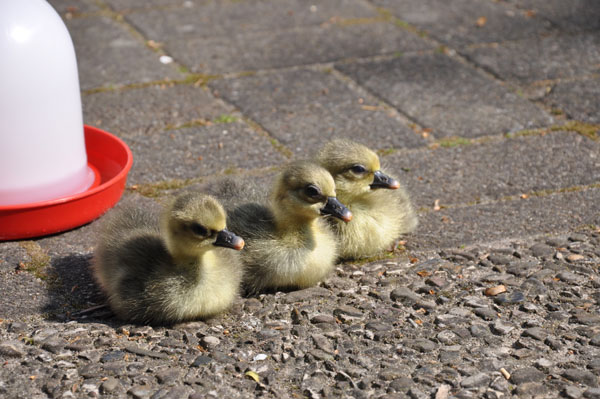
Weeks and months now go by in which three goslings follow us every step of the way. Our entire day, from sunrise to sunset, revolves around our “offspring”; we are living through a summer among geese and out in the open.
The first two days are still fairly quiet, though, because the little ones are not hungry yet. They live off the egg yolk they drew in just before hatching. They also tire quickly and want to get under the “plumage” of their parents (our jumpers) before they get cold.
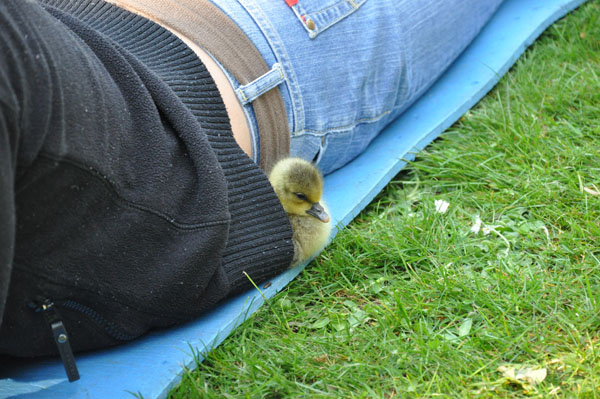
But that changes so quickly that we hardly know what has hit us. Suddenly we have to spend the whole day outside without a break: living outside, eating outside, sleeping outside (goose nights are short, so we catch up on our sleep during the day). And that in every kind of weather and at every temperature.
The reason behind it is what is known as imprinting: geese are precocial birds. That means the young leave the nest with their parents soon after hatching and do not come back. But knowing what their parents look and sound like is not inborn. So that the little geese know whom they have to run after in the coming months, and who will look after them and protect them, they have to learn within a short time who their parents are. With the parents’ voice this happens before hatching; the parents’ looks are then imprinted right after hatching. Any living creature that responds to the little geese, above all by answering their calls, is accepted as a “parent”.
So Leno, Julchen and Fussel have imprinted on us, and now they follow us everywhere. To outside observers it looks very “cute” when they always run after us. For us, however, it means that they ALWAYS run after us. We cannot leave them alone for a single minute without them starting to “cry” dreadfully. Accordingly, from now on we do not have a single minute to ourselves either.
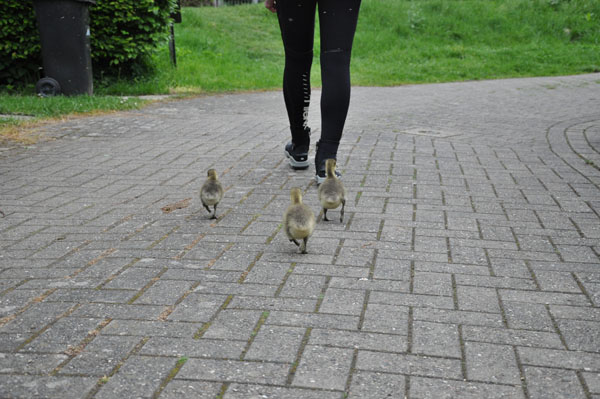
At night the geese sleep in their little pen at first, a room next to our living quarters, but during the day the job now is to show them their new world outside. To begin with, the garden is enough for them, with a water hole dug especially for them. Pretty soon, though, we move on to the little stream behind the house, then to the shore and into the reeds of the lake. In the end we also explore the neighbouring meadows with them.
The very first thing we learn is that geese view anything new with the deepest suspicion. Even a white feather lying on the path we use every day can be reason enough to refuse to walk on. If we, unknowing and therefore unimpressed by the feather, simply try to keep going, the three make it clear with loud shrieks that they are not willing to follow us. But they are just as unwilling to stay behind alone. In such situations, which we have to deal with quite often in the months to come, the thing is to find a healthy middle way. On the one hand, the geese should get over themselves now and then and explore something new; on the other, they should not be exposed to too much stress.
In the first few weeks our job really consists only of walking the little ones to places with good food and protecting them on the way. At the beginning, you see, small goslings are attractive titbits for cats, goshawks and crows, though less and less so later on. We try to keep as far away from other people as we can. After all, the three are supposed to live among wild geese later, not to join strangers on the lakeside promenade. Even more, though, we dread the accompanying “he-wouldn’t-hurt-a-fly” dogs. Because, to the amazement of many dog owners, the “oh-so-sweet member of the family” cannot keep its instincts under control once three little balls of feathers run off squeaking right under its nose. Then, perfectly understandably from a dog’s point of view, the hunting instinct does break through. The embarrassed owner will regularly explain to us: “He’s never done that before, honestly.”, but the shock always goes deep. After the first critical encounters we learn from the wild geese we regularly meet at the lake: as soon as a dog comes into view, we flee with our offspring into the water or the neighbouring reeds.
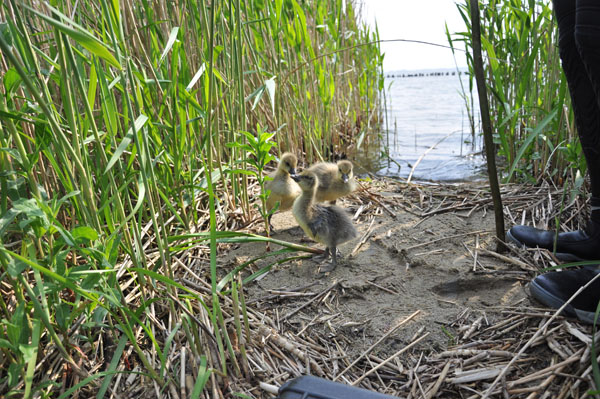
As for the actual goose skills, that is
- finding edible plants
- swimming
- bathing / escape diving
- preening
the three can really do it all on their own. Some things are certainly open to improvement. A goose, for example, also has to learn first that it is best to land into the wind. So at the beginning, before this piece of knowledge is there, we get to see some extremely athletic landings. But a great deal of the basic knowledge is obviously programmed into their genes.
We also learn quickly that a goose’s life consists, very simply and very consistently, of 4 activities:
- eating together,
- sleeping together,
- preening together (regularly after bathing together)
- and ... leaving little heaps together.
Amazingly, the latter is carried out continuously during the first three phases. Always. Without exception. It soon seemed little short of a miracle to us how three such small balls of feathers, no bigger than a fist, can leave behind such a mess! According to our rough estimates, a young goose leaves behind about its own body weight every day in the form of digested grass. With geese the size of a tennis ball that is still bearable. But after only 4 weeks the first goose (Leno) breaks the one-kilo barrier. The other two follow close behind. That already makes almost 3 kilos of leavings, a good part of which still ends up in our garden or on the paths around the house. To protect the garden and the neighbourhood, we collect the end products of metabolism with a dustpan practically every hour. Another way of filling the compost bin ...
In keeping with the heaps, of course, there is also non-stop eating. At first young, tender greens that are easy to pluck, such as clover leaves. Later, though, more and more finds its way onto the menu. On the riverbank, mosquitoes are hunted under nettle leaves, every daisy is beheaded, every dandelion has its neck wrung. Our lawn is also systematically trimmed, every last blade plucked at - we do not need to mow the garden for 3 months.
And a little goose like that also knows, as a matter of course, that it has to eat sand and small stones. These help in its kneading, muscular stomach to break down all that hard-to-digest greenery, so that the body can actually absorb the nutrients.
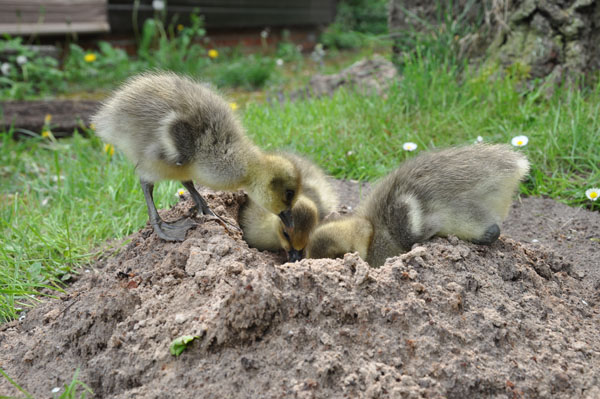
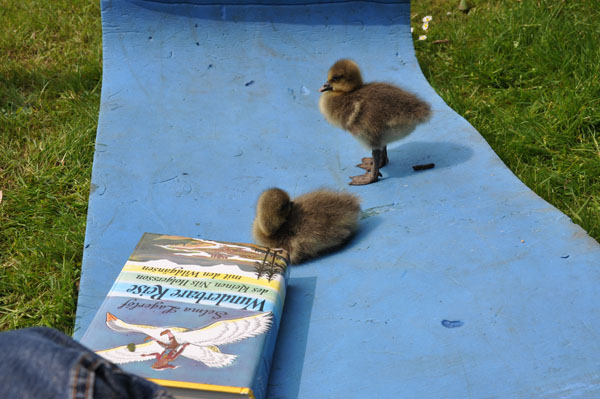
Between every meal they sleep. At first still with us under our jumpers, but in real goose life, too, at some point the goslings simply no longer all fit under their mother’s feathers. So the three more and more often just snuggle up in a heap, their little heads tucked under their still rather pitiful wing stubs. The bigger the three get, the shorter the sleeping units become, and the feeding units stretch out accordingly, in time and in quantity. Little geese do not have much time and have to get a move on: within the first four weeks they increase their hatching weight tenfold.
Little by little the three also venture a bit further away from us while feeding, but they stay within sight and, above all, within hearing and calling distance. For sleeping, though, they always come pattering back, snuggle up to our trouser legs or, as it gets warmer, settle in our cool shade.
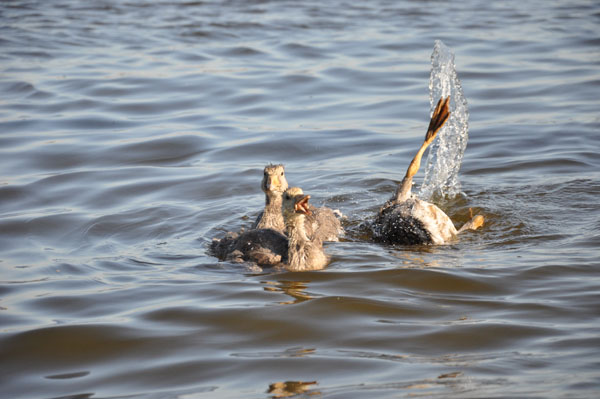
The warm weather then also brings long daily sessions of bathing and splashing about. Although the little ones started preening and arranging their fluff on the very first day - even before they pecked at their first blades of grass - it is only the hot weather that shows how much fun they have in the water. As true waterbirds they bathe, splash and dive until everything is thoroughly wet. After that, there is plenty of sorting, preening and oiling to do.
The first flight
Just two months after our geese hatched from their eggs as fist-sized goslings, the moment comes on 28 June. It is only a few metres, but still: all of a sudden the three take off and are quite taken aback themselves at first.
The occasion is what has by now become our traditional sprint on the way from the house to the lake. One of us runs ahead and the geese race along behind, flapping their wing stubs. Only by now the wings are no longer just stubs. Somehow that has escaped the geese so far. The leader of the troop, on this morning it is Olly, suddenly finds himself surrounded by rushing wings for a few seconds, and then the three are past him. Suddenly, with no “lead goose” ahead of them, our heroes lose their nerve. On top of that, a hedge is coming towards them at astonishing speed. When the wings are suddenly just folded in, a fair amount of inelegant stumbling follows. On this morning the geese experience their first belly landing, and their first lesson. In the days and weeks that follow, the three learn in exemplary fashion not simply to break off a flight, but to plan it carefully and to land into the wind.
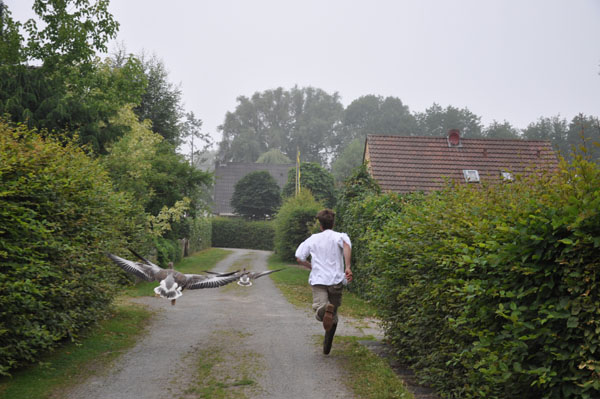
Now things move fast. Only a week and a half later the geese fly from the house to the lake on their own, with a little help from us for take-off. At first, though, they cannot find the way entirely without our support: from the air the familiar area does look a bit different, and sadly we cannot fly ahead to show them the way. As soon as the three no longer see a parent in front of them, they want to turn back and fly to wherever they lost their “lead goose”.
So we think up a trick: equipped with radios, we split up in the morning. One of us stays at the house with the geese, the other sneaks off to the lake. There, about 300 metres from the house as the crow (or goose) flies, the latter stands far out on the jetty, in plain sight, and reports in by radio. Now the one at home leads the geese to the “runway”, a long, straight stretch pointing directly at the lake. Since the geese have come to enjoy flying and also want to get to the lake quickly, a few steps are usually enough and they are in the air. This is reported by radio too. The “lead goose” at the lake now bellows for the geese at the top of their lungs, while the one at home quickly hides. Somewhat confused, the geese follow the calls to the lake and are quite surprised to find one of us there. But by the third day it is pure routine: take-off, flight to the lake, landing. Almost boring for three frequent flyers.
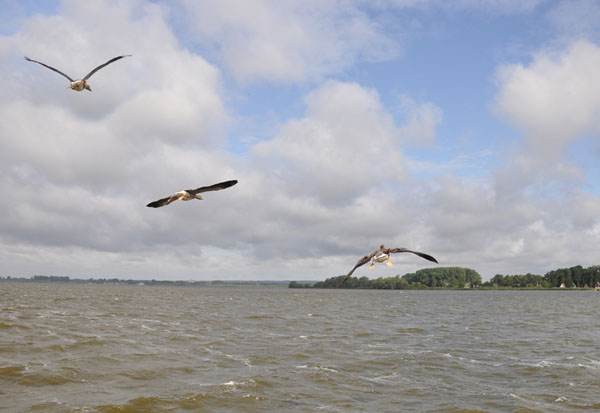
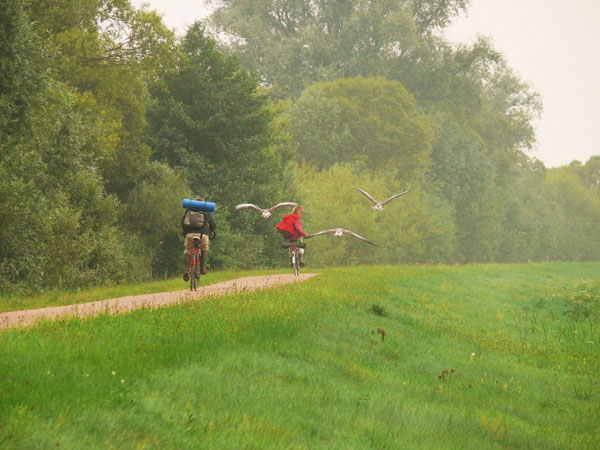
In the months that follow, our loud calling for the geese becomes a familiar background noise for the residents and walkers at the lake. We now regularly encourage our geese in this way to fly to us or with us. Our bicycles have also proved their worth. Until now, if we wanted to get to some meadows with wild geese, we had to wade straight across the lake. Now we ride ahead on our bicycles and the geese follow us. There are stopovers again and again, because we cannot ride as fast as the geese fly (and sadly the geese cannot fly as slowly as we ride). It is laborious at times, but this way is certainly faster than going through the water, and the geese now also get to know from the air the landscape they already know from the ground.
The people living along the dyke soon notice that we come cycling and flying past with our geese regularly every morning. Before long a few interested onlookers are standing ready each day with binoculars and cameras, waiting for us.
But we have made another discovery by now: in inflatable boats we can explore the lake and its outflows in a very relaxed way, without getting wet or things getting too strenuous for us “human parents”. Soon we can be seen drifting lazily on the water for hours on end, while the geese dabble, bathe or simply take a nap. And nothing is as relaxing as taking a nap in an inflatable boat under the trees by the shore, just like the geese. The good old computer games like Monkey Island get played through one more time on the mobile phone too. Not to mention the masses of books we devour this summer while enjoying the good weather with our offspring. At the sight of this, many a walker may think that the life of a goose must be pleasantly lazy for us humans. Few stop to think that we sit in the very same spots in pouring rain as well, armed only with oilskin jackets and trousers. Many an evening we dry our books in front of the heater while the geese are already asleep.
Weaning
From the beginning of August we slowly start to wean our geese. To do so, we first leave them alone for a while during the day. At first just for an hour, and preferably when they have just been asleep. Because then the three are hungry and in no mood to follow us. They would rather fill their bellies first. It works less well, on the other hand, when the belly is full. Because then a goose wants to sleep or preen. And that, of course, is something you do in comfort, as a group. If part of the group then moves on, everybody moves on.
On 3 August the moment comes: at the age of 3 months, we set out onto the lake in the evening in our inflatable boats to teach the three how REAL geese sleep. Until now we have always marched back to the house at dusk, and the geese have spent the night in their “nursery pen”. But now that they can fly safely, we think the time has come to show our offspring the true goose roosts. This matters, because the fox regularly drops by on the meadows at the lake. So that is no place to sleep the night away. As good parents, of course, we have to lead by example.
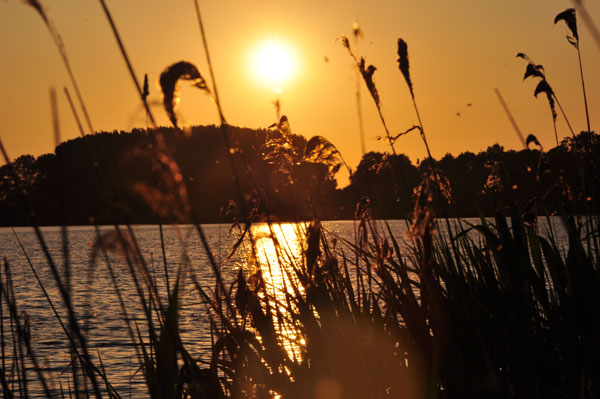
Most nights are glorious. It is warm, cloudless and still. We sleep wonderfully in our inflatable boats, and the geese clearly like it too. They always stay near us, drift dozing alongside our boats, or swim into the shallows to go about their goose-night activities. When the Perseids, a meteor shower that comes round every year, reach their peak, the Dümmer region is one of the few cloudless spots in Germany, and we spend an unforgettable night on the lake with hundreds of shooting stars an hour. We meet the few nights of light rain with tarpaulins that we have stretched halfway over our boats. As soon as it starts to spit, we simply pull them over the whole boat and wait until the rain has passed.
In mid-August the time comes to slowly leave the geese to themselves at night as well. We quietly sneak off for an hour, to be back at the jetty just in time for dawn. Over the following nights we extend the time the geese are alone. But we are always back by dawn, to make sure that the three do not come ashore on their own and go on sleeping there. And to reassure them, at least one of the familiar inflatable boats always stays behind. The geese notice at once, of course, that it is empty, and they loudly vent their displeasure at our absence, but an empty inflatable boat is obviously better than nothing. As we can see from our hiding places in the bushes, they first go back to the familiar boats if they cannot find us. After a few days they have learned that we come back, and they also move further away from the jetty towards the reeds now and then.
In the end we have them to the point where we leave them alone on the meadows in the late afternoon. At dusk they come flying on their own to the familiar roost on the lake, where we are waiting for them. We spend a little more time with them and then leave them to themselves again. The next morning we usually meet them for breakfast on one of the meadows nearby.
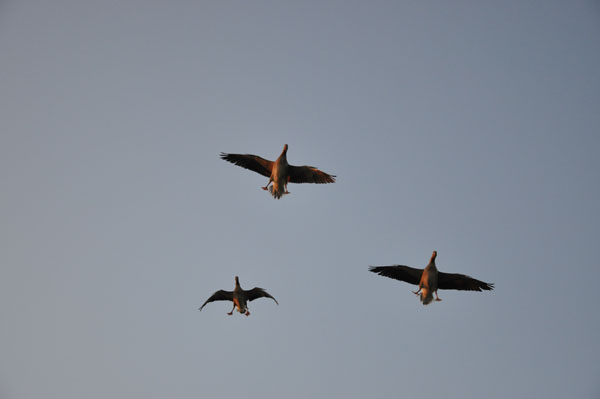
But it is also during this time that we have the most terrible experience of our goose summer: one evening at the beginning of September we are sitting by the lake, waiting as always for them to arrive. On the surrounding meadows and fields we can hear the hunters shooting again, because since the beginning of August greylag geese, among others, may be shot. And the local hunters are doing just that, clearly audibly and pretty regularly. It gets darker and darker, but no geese come flying in to go “to bed” with us. Long after it has gone pitch dark, we go home with the terrible suspicion that our geese have ended up in the cooking pot. It is a very restless night, and we need no alarm clock to wake us in the morning. To our great relief, when we arrive at their regular meadow, the three greet us unharmed and in the best of health, cackling loudly.
Farewell
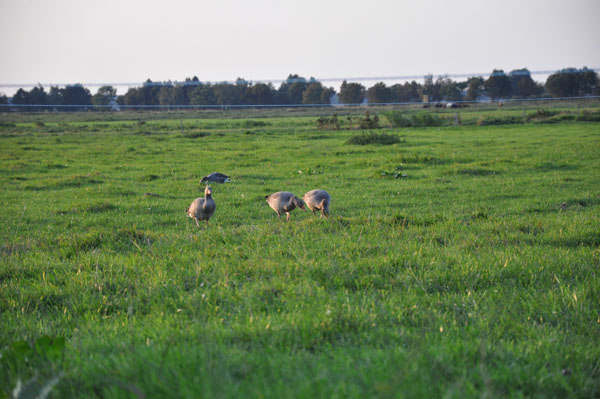
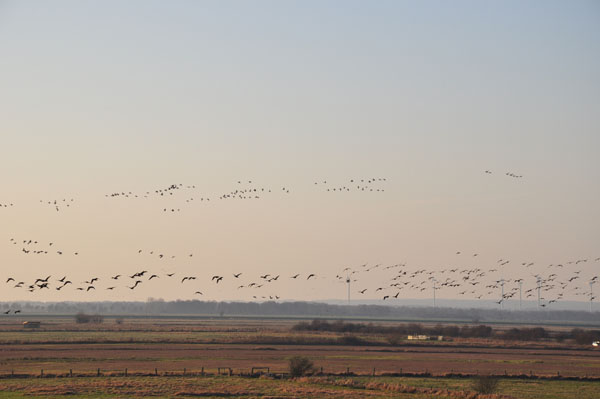
From the beginning of October, more and more winter guests from the north arrive at Lake Dümmer. Huge flocks of wild greylag, white-fronted and bean geese come to the region. We also spot the odd barnacle, Canada and Egyptian goose.
Our three seem to like this very much. Especially when they learn from the wild geese how wonderful it tastes to plunder a harvested maize field! Until now we could say with certainty where to find them during the day, but now the time has come when we lose sight of them more and more. The gaps between our meetings grow longer and longer, and when we do see them, they are always out and about with a flock of wild geese.
What a glorious feeling to call our “komm komm” (“come, come”) to wild geese (eyed suspiciously by a few last walkers) and to have three geese come towards us out of a huge flock!
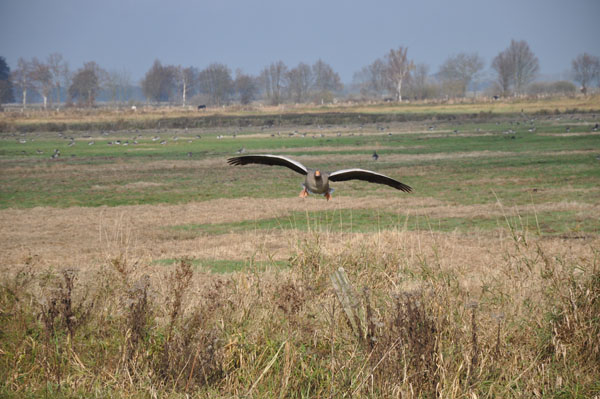
We watch this development with one eye laughing and the other crying. Our time among geese is inevitably drawing to a close, and we have to let them go. But joy wins out, because our three geese are flying free with their wild relatives, just as planned. For nothing can offer our three a safer and happier future than living among wild geese. A goose’s safety depends above all on the protection a flock offers. A thousand eyes spot the fox sooner than six, and a flock of geese is led by old, experienced geese. They know, for example, how and where to find food on the fields even in deep snow, or water even when Lake Dümmer is frozen over.
There is one more time when we “get to” be goose parents through and through: in mid-October we find Leno injured. She seems to have flown into a barbed-wire fence and has a deep wound on her wing. We take her to the vet, where the wound is stapled and she is prescribed antibiotics.
For five days Leno has to stay in her sickbed, which she does only unwillingly. But there is no other way for us to make sure she takes the antibiotics regularly and keeps the wing still. So the old nursery is made ready again, and one of us is with her all the time to offer her a mini flock as a substitute. At night we sleep beside her in the straw, and she gabbles plaintively, asking when she may go back to freedom.
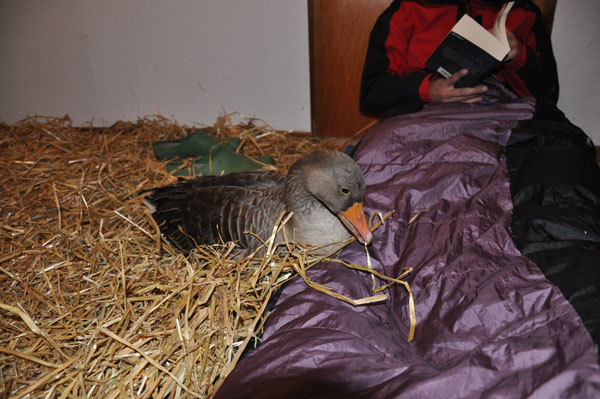
We would most like to release Leno when Julchen and Fussel are around. Because we are afraid that otherwise the three will find it hard to meet up again among the thousands of wild geese. But it is not to be. For 2 days we cycle up and down the usual places, calling loudly, and all we get is funny looks from wild geese.
But since Leno is slowly going stir-crazy, we let her go anyway. First she plunges into Lake Dümmer for a bath. Then she flies to a flock of wild geese resting on the meadows. She ignores us, probably as a punishment for locking her up for five days.
And indeed, we do not find the three together again this autumn. Fussel and Julchen have joined a different flock from Leno. These two flocks apparently do not cross each other’s flight paths. At first this worries us a little, but they all seem to be getting on fine like this as well. At any rate we see all three of them at different times, and Leno’s injury is healing well too, for she is lively and flies without any trouble.
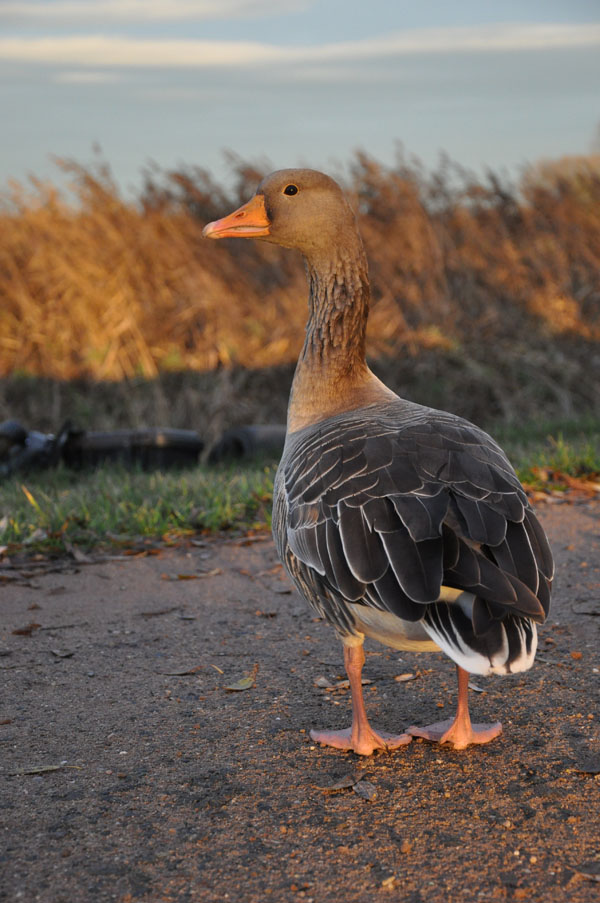
The last meetings get colder and colder, and so really uncomfortable for us. The geese, of course, do not mind in the least. It turns November, and spending time with our nearly grown-up children on the cold meadows becomes a real challenge. We notice how our geese have already adapted their behaviour to the wild ones. They have become much more alert and easily startled. We take this as a good sign that they are prepared for the coming winter and for the time after it.
The (provisional ?) end
Now that we hardly ever meet our three and it is simply getting too cold in our summer house, we pack up and leave. A goose summer lies behind us, and our three charges are now grown up and free, out and about with the wild geese. A little astonished but happy, we find that everything has worked out just as we planned and hoped! We still wonder whether they will get through the winter all right. But the three have shown us for long enough that they can cope. Should they need help in the future, they have the most competent teachers around them.
What a wonderful time, living as part of a goose family. And perhaps we will be lucky enough to meet our three again at Lake Dümmer next spring.